
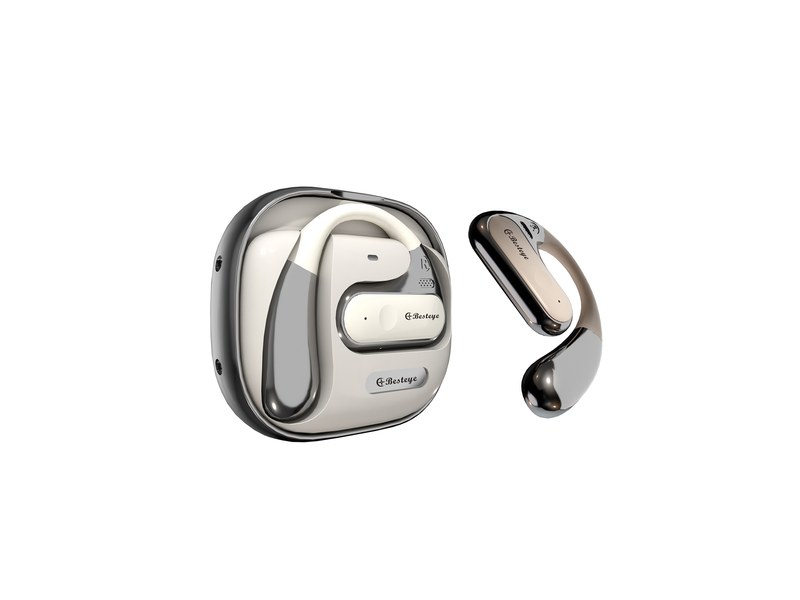
If you have ever tried to tune a pair of TWS earbuds, you already know — changing one component affects everything else. The speaker driver, battery capacity, microphone placement, ENC algorithm, and ANC filter all interact in ways that are not obvious from the datasheets alone. This article goes through each major component and explains how its characteristics ripple through the rest of the system.
1. Speaker Driver — The Starting Point
The driver is the most consequential component in a TWS earbud. It sets the baseline for sound quality, power consumption, and even physical ID design.
Dynamic drivers (6mm to 13mm) are the most common in TWS. A larger driver can move more air, which translates to better bass response and higher maximum SPL. But a larger driver needs more power. A 10mm dynamic driver typically draws 30–50 mW at normal listening levels, while a 6mm driver draws about half that. If you pair a 10mm driver with a 35 mAh battery, you get roughly 4 hours of playback. The same battery with a 6mm driver gives 6–7 hours.
Balanced armature drivers are less common in TWS because they are harder to tune in a small sealed chamber. They are more efficient in the mids and highs but lack bass extension without a separate bass driver or a tuned bass port. A few premium models use a hybrid configuration — one dynamic driver for low frequencies and one or two balanced armatures for mids and highs. This works well acoustically but doubles the crossover components and increases the required PCB space.
The driver choice also determines the back cavity design. A sealed cavity (closed-back) gives better bass and isolation but requires a rear vent that has to be precisely dimensioned. A ported cavity gives more natural sound but leaks low frequencies into the environment, reducing ANC effectiveness.
2. Battery — The Limiting Factor
Battery capacity in TWS earbuds ranges from 25 mAh in entry-level buds to 60 mAh in larger models. The charging case adds 300–500 mAh. The cell voltage curve directly affects the ANC and audio performance.
As the battery drains from 4.2V to 3.3V, the maximum output of the audio amplifier drops. If the ANC chip is powered from the same rail, its noise cancellation depth can degrade by 3–5 dB near the end of the battery cycle. This is why some mid-tier earbuds sound fine at 80% battery but noticeably worse at 20%. The fix is either a boost converter that regulates the audio rail voltage (adds cost and PCB space) or a battery with a flatter discharge curve (adds cell cost).
Fast charging requires the charging IC to handle higher current without excessive heat. Most TWS buds charge at 0.5C to 1C. Beyond 1C, the cell temperature rises by 8–12 °C inside the earbud, which can degrade the adhesive holding the driver in place over hundreds of cycles.
For OEM/ODM projects, we recommend specifying the battery discharge rate together with the ANC spec. If the ANC target is 25 dB or higher, a regulator with at least 90% efficiency across the voltage range should be used. Otherwise the user experience degrades noticeably halfway through the day.
3. Microphone Array — Where ENC and ANC Part Ways
Modern TWS earbuds use two or three microphones per bud. A typical configuration: one feed-forward microphone on the outer face (for ANC ambient sampling), one feedback microphone inside the ear canal (for ANC error correction), and one beamforming microphone aimed at the mouth (for calls).
ENC (Environmental Noise Cancellation) is purely a signal processing technique applied to the microphone feed during calls. It uses the secondary microphone to model the ambient noise and subtract it from the primary mic signal. ENC works well for steady-state noise like HVAC hums and airplane drone, but it struggles with sudden transient sounds like a door slam or a passing truck. The quality of the ENC depends heavily on the microphone pair matching. If the two mics have different sensitivity curves, the subtraction algorithm will not cancel the noise effectively and may introduce artifacts.
ANC (Active Noise Cancellation) creates a phase-inverted sound wave through the speaker to cancel ambient noise inside the ear canal. ANC is not related to the microphone pick-up for calls — they serve different paths. ANC uses a dedicated DSP or ANC chip (such as the BES2300 or QCC5141) that runs a feedback loop at 100–200 kHz. The ANC effect drops off above 1 kHz, which is why passive isolation (ear tip seal) is still critical for high-frequency noise reduction.
Here is where they interact: the feed-forward microphone used for ANC is also used by the ENC algorithm. If the ENC algorithm reuses the ANC mic signal without proper band splitting, you get audible pumping artifacts during calls. The latest chips separate these paths internally, but custom tuning is still required to balance them.
4. How ANC Affects the Audio Tuning
When ANC is active, the driver is reproducing both the audio signal and the anti-noise signal simultaneously. This means the driver sees a higher electrical load. The amplifier must deliver enough headroom to produce clean audio + ANC waveform without clipping.
In practice, ANC can reduce the maximum clean SPL by 3–6 dB, depending on the driver sensitivity and the ANC target depth. A driver with 105 dB SPL at 1 mW may only reach 99 dB with ANC on. This is not an issue at normal listening levels (70–85 dB), but it becomes noticeable with quiet classical passages or podcasts at low volume — the ANC floor becomes audible as a faint hiss.
This hiss is the noise floor of the ANC loop itself, and it varies by chipset. The Qualcomm QCC5141 has a noise floor around -105 dBV. The BES2700 is closer to -98 dBV. For products targeting a premium listening experience, the ANC chip choice should match the driver sensitivity.
5. The Interaction Chain — Real World Tradeoffs
Here is a concrete example from a TWS project we worked on:
The client wanted 8 hours of playback with ANC on, 12 mm drivers for bass performance, and triple-mic ENC. The initial battery calculation came out to 65 mAh per bud. That made the bud physically larger than the client’s ID design allowed. To fit the design, we had to reduce the battery to 50 mAh and reduce the ANC depth from 28 dB to 22 dB at the low end. The tradeoff was acceptable for the client’s target market (mid-range consumer), but we documented the change because the ANC would not compete with flagship models.
If we kept the 28 dB ANC but switched to a 6mm driver, the battery life jumped to 10 hours. But the bass rolled off below 80 Hz. For a bass-heavy music profile, the client would have needed to add a passive radiator or bass port — which added 0.8 mm to the earbud depth, the same dimension we had just saved by reducing the battery.
This is the reality of TWS design: every component change triggers a chain reaction through at least two other subsystems. The best approach is to define the target specifications clearly — battery life, ANC depth, audio quality baseline, physical size — and then optimize the component set in a single pass, not piecemeal.
6. Manufacturing Implications
On the production side, the interaction between components affects the assembly yield. Microphone placement that works well in a prototype tool may shift by 0.2 mm in a production mold, which degrades the ENC performance and requires re-tuning. Speaker driver sensitivity varies by ±1.5 dB within a single batch. If the ANC is tuned to the nominal value, units at the edges of the tolerance band may exhibit oscillation.
In our factory, we run every production batch through an ANC response test and a microphone gain calibration. The data feeds back to the SMT line to adjust component placement. This reduces the unit-to-unit variation from ±3 dB to ±1 dB. It adds 8 seconds per unit to the test cycle but cuts field returns by roughly 60%.
Understanding these interactions early in the design phase saves time, reduces iterations, and results in a product that sounds consistent across the full production run rather than only in the lab prototype.
If you are developing a TWS product and need guidance on component selection or acoustic tuning, reach out to our engineering team.